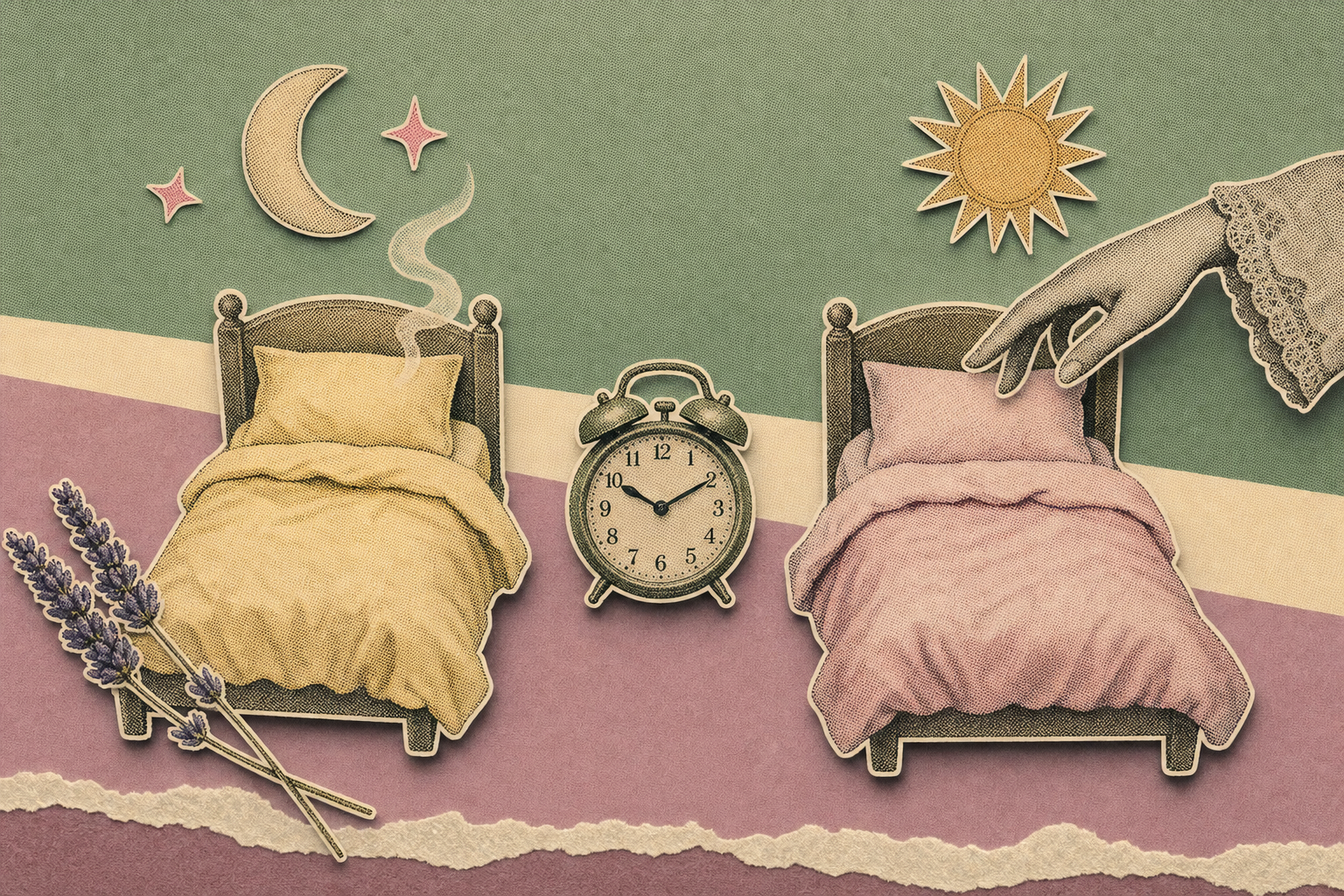
The 'Sleep Divorce' Trend: Why More Couples Sleep Apart — and What It's Doing to Their Sex Lives
"Sleep divorce" is one of those phrases that sounds like a breakup and turns out to be the opposite. Roughly a third of US adults in long-term partnerships now report sleeping in separate beds or rooms at least part of the week, and the conversation around it in 2026 has flipped from "warning sign" to "wellness move." The piece every trend article skips: what it actually does to your sex life.
What is a sleep divorce?
A sleep divorce is any intentional arrangement where partners sleep in separate beds, separate rooms, or even separate apartments most nights, while remaining in a committed romantic relationship. It is not a separation. The label is deliberately dramatic — the practice is mundane.
Sleep research groups put the prevalence at somewhere between 25 and 35% of US couples in long-term partnerships, with snoring, mismatched schedules, temperature preferences, restless legs, and post-baby exhaustion as the most-cited drivers. The 2026 trend is the rebrand: from "we had to" to "we chose to."
Why is sleep divorce having a moment in 2026?
Three threads converged. Sleep quality became a primary wellness metric — wearables, sleep coaches, and culture writers all started treating bad sleep as the silent cause of everything from low libido to short tempers. At the same time, the soft-life and slow-life trends made it culturally acceptable to admit that you needed eight uninterrupted hours more than you needed to spoon someone who snores.
The third thread is the one this post cares about. As phone-free dates and slow-sex content trended in parallel, "intentional intimacy" stopped being a couples-therapy phrase and started showing up in mainstream lifestyle coverage. Sleep divorce slots neatly into that frame: if intimacy is going to be a thing you do, not a thing that happens to you, the same bed every night actually matters less than people assumed.
What does sleeping apart actually do to a couple's sex life?
The honest answer: it depends entirely on whether the couple replaces "we're both in the bed" with another structure. Surveys of couples who tried sleep divorce in 2025-2026 split into two clear camps.
The "best thing we ever did" camp (roughly 60-70% of respondents in available data) reports more sex, not less, more intentional sex specifically, and a clear improvement in libido — usually attributed to better rest. The mechanism is simple: sex becomes a scheduled or chosen event rather than a "maybe if neither of us falls asleep first" lottery.
The "we drifted apart" camp (the remaining minority) almost always reports the same failure pattern: no replacement ritual. Two people in two rooms with no plan for the bridge between them eventually stop building one. The variable isn't the separate beds; it's whether they replaced the passive cue.
Couple Sex Toys | Enhance Shared Pleasure & Intimacy Couples toys that work just as well in a shared bed as in two separate ones — connection, not co-sleeping. Shop category →How successful sleep-divorce couples design for intimacy
The patterns are remarkably consistent across the reporting. Couples who make sleep divorce and a good sex life work tend to share three habits:
- A nightly hand-off ritual. Twenty to forty minutes together before separating — same bed for a while, no phones, talk or touch or read. This is the new shared-bed analog for "winding down together."
- An explicit "stay" signal. Couples agree in advance on what means "come over tonight." A text, a candle in the hallway, a knock — anything that converts an invisible expectation into a clear request.
- One designated "sex bed." Almost universally, the couple keeps one of the two beds as the default location for sex (usually the bigger one, often the one in the primary bedroom). The other becomes purely a sleep bed.
The third habit matters more than it sounds. Couples who try to make both beds equally intimate-and-restful end up making neither work well. The brain learns by location; giving sex its own space inside the home — even just a bed-shape worth of space — seems to make the "show up on purpose" easier.
 Satisfyer Partner Box 1
Couple's starter kit — easy to grab from one nightstand and walk down the hall when intimacy is scheduled, not assumed.
View product →
Satisfyer Partner Box 1
Couple's starter kit — easy to grab from one nightstand and walk down the hall when intimacy is scheduled, not assumed.
View product →
Is sleep divorce a relationship red flag?
Not by itself. Therapists who've been polled on the trend in 2026 consistently say the question isn't are you sleeping apart, it's are you using the time you're awake together well. Two people who share a bed and never touch are a quieter problem than two people who sleep in different rooms and intentionally meet in the middle.
The trend's mainstream coverage often skips this part: roughly 8 in 10 sleep-divorced couples in available US surveys describe their relationship as "the same or better" after the change, with sleep quality almost always reported as the biggest gain. Sex satisfaction is reported as improved more often than not, but only when the couple actively built a ritual into the new setup.
If your relationship's intimacy already runs mostly on "we're in the same bed so something might happen," you'll need to replace that engine before you take the bed away. For the underlying communication work, our guides on improving intimacy in couples, keeping passion alive long-term, and reclaiming desire when life gets in the way are the place to start before the second mattress arrives.
How to try a "soft" sleep divorce without committing
You don't need a guest bedroom or a real estate change. The lowest-stakes version of the trend is the "weeknight separation": Sunday through Thursday in separate beds (or one of you on a quality couch), Friday and Saturday together. Couples who try this version usually report two things — they sleep dramatically better on the separated nights, and the shared nights start to feel like dates again instead of defaults.
If even that feels like too much, the gateway version is the "midnight migration": both partners start the night together for the wind-down and the first sleep cycle, and whoever wakes up restless migrates to a second bed or the couch. About 40% of couples who eventually do a full sleep divorce report they started this way.
FAQ: Sleep divorce and your sex life
Doesn't sleeping apart kill spontaneous sex?
It changes spontaneous to intentional — which most sleep-divorced couples describe as a net positive. Spontaneity in long-term relationships is often a story we tell about what already wasn't happening. Intentional sex tends to actually happen more, not less.
How do you have sex when you sleep in different rooms?
The successful pattern: one bed becomes the default "intimacy bed" (usually the bigger or main-bedroom one). One partner texts, knocks, or signals an invitation. The couple meets in the sex bed, and the second bed stays for sleep only. The setup is functionally similar to dating someone you live with.
Is sleep divorce more common in long marriages or new relationships?
Available US data points to long marriages, peri-menopausal couples, and couples with young kids as the highest-prevalence groups. The 2026 trend coverage suggests the practice is starting earlier in relationships than it used to.
Will I feel less close to my partner?
Couples consistently report the opposite — provided they replace co-sleeping with a wind-down ritual and an intentional reconnection plan. "Closeness" turns out to be mostly about presence during waking hours, not unconsciousness in the same room.
What if only one of us wants this?
Start with a trial period — two weeks — and an agreed-on review conversation at the end. Many partners flip from "this feels like rejection" to "I'd never go back" once they get their first stretch of good sleep. The trial frame removes the permanence anxiety.
Is sleep divorce a sign we should go to therapy?
Only if the rest of the relationship is showing strain. Sleep divorce on its own is overwhelmingly reported as a sleep-quality and sex-quality improvement. If it's coupled with avoidance, conflict, or low-grade resentment about something else, that's the part worth taking to a therapist.